A lot of you are expecting this article to start with 🎷”werey lafin wo werey.” Lai Lai.
If your mum is Iya Bose from Ajalekoko Street, Okoko-Maiko, just scroll quietly 😅
This article is not for you.
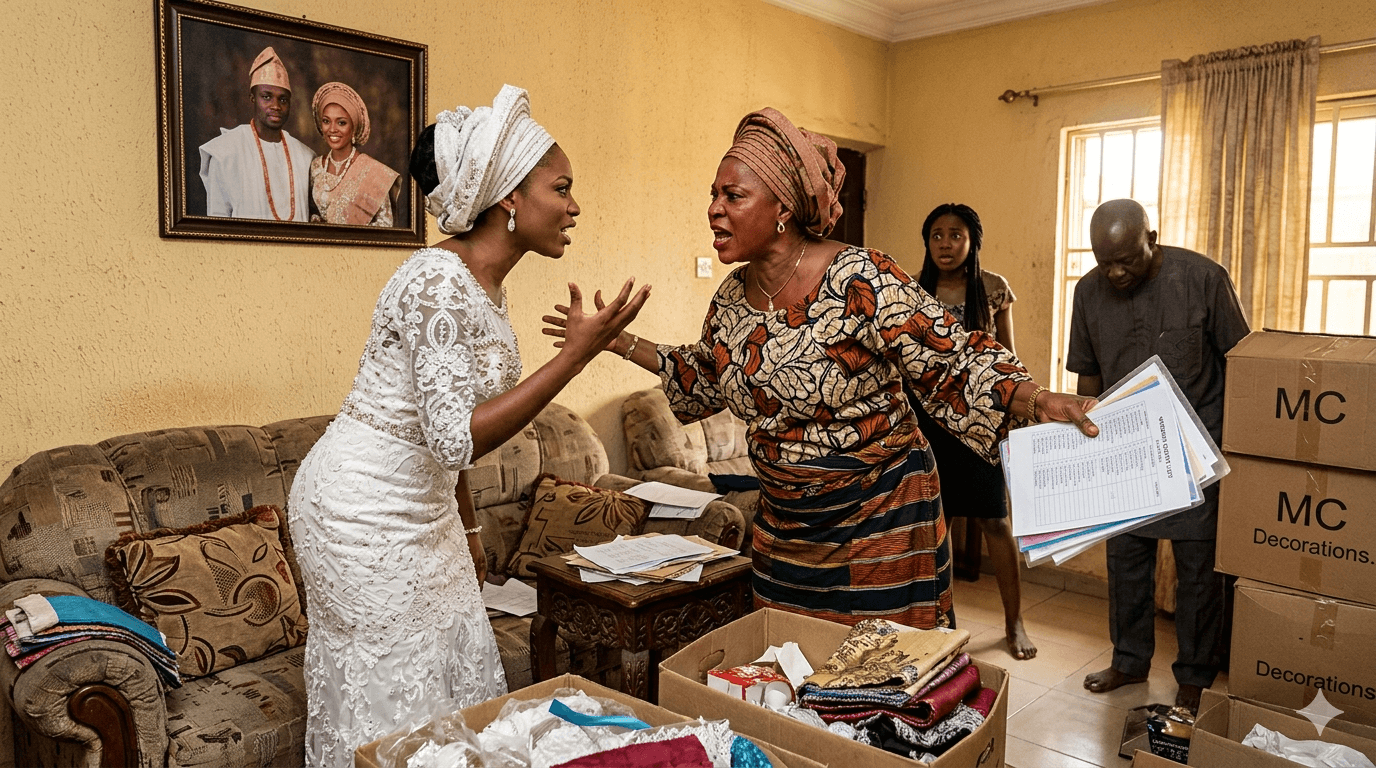
That woman has been planning your wedding since before you were born. Guest list, the 3 different outfits she will wear, aso-ebi, even the MC, all sorted.
You? Just the project manager.
But if you’re trying to take your wedding back without causing a family meeting, keep reading
Weddings in Nigeria are beautiful, loud, emotional, and let’s be honest, full of opinions.
From your mum’s “small suggestion” that somehow adds 150 extra guests, to that aunty who insists your aso-ebi must be gold because “that’s what fits your complexion,” it can start to feel like your wedding is no longer yours.
And here’s the tricky part: these are people you love and respect. So saying no? It feels uncomfortable… almost like you’re being disrespectful.
But let’s be clear from the start:
You can honour your family and still have boundaries.
This guide will show you exactly how to say no politely, wisely, and without damaging relationships.

Why Saying No Feels So Hard (Especially in Nigerian Homes)
In many Nigerian families, weddings are not just about the couple. They’re a family affair.
There’s culture, pride, and reputation involved:
- “What will people say?”
- “This is how it’s always been done.”
- “After all we’ve done for you…”
Add that to the deep-rooted respect for elders, and suddenly, a simple “no” feels like rebellion.
And if family members are contributing financially?
It can feel like they’ve earned a say in every decision.
So if you’re feeling pressured, confused, or even guilty, you’re not alone.
This is a very normal part of wedding planning in Nigeria.
First, Accept This Truth: You Can’t Please Everyone
Let’s not sugarcoat it.
Even if you say yes to everything:
- Someone will still complain
- Someone will still feel left out
- Someone will still have “advice”
So the goal isn’t to make everyone happy.
The goal is to make peaceful, intentional decisions you can live with.
Because at the end of the day, you’re not planning a wedding for Instagram or extended family. You’re starting a marriage.
Know What Matters Most (Pick Your Battles)
Before you start saying no to people, get clear on your own priorities.
Ask yourself:
- What do I really care about?
- What can I compromise on?
- What will I regret if I don’t stand my ground?
A simple way to do this:
- Non-negotiables (e.g., guest limit, budget, bridal look)
- Flexible areas (e.g., souvenirs, small décor details)
For example:
You might allow your aunty to handle souvenirs, but not your guest list.
Clarity makes saying no easier and more confident.
How to Say No (Without Sounding Disrespectful)
Now to the part you’ve been waiting for.
Saying no doesn’t have to be harsh. In fact, the tone and delivery matter more than the actual words.
Here’s a simple formula that works:
1. Start With Appreciation
Nigerian parents and elders respond well to respect.
“Mummy, I really appreciate how much you’ve been supporting this wedding…”
2. State Your Decision Calmly
No long stories. No over-explaining.
“…but we’ve decided to keep the guest list at 150.”
3. Give a Simple Reason (Optional)
Use neutral reasons like:
- Budget
- Venue capacity
- Stress management
4. Offer an Alternative
This softens the “no.”
“We can’t add more guests, but we’ll make sure they can watch via livestream.”
5. Use “We” Instead of “I”
This reduces pressure and shows unity.
“We’ve decided…” instead of “I don’t want…”
Real Nigerian Wedding Scenarios (And What to Say)
Let’s make this practical.
1. “Add These Extra Guests”
“Our venue has a strict limit, so we have to stick to the number we already planned.”
2. “Use This Aso-Ebi Color”
“We’ve already chosen our colours, but we’d really love your help with something else.”
3. “Do It the Traditional Way”
“We’re simplifying a few things to make the day less stressful, but we still want to honour the culture.”
4. “Invite This Entire Village”
“We wish we could host everyone, but we’re working with a fixed budget and space.”

What If They Don’t Take It Well?
Let’s be real: some people won’t.
They may:
- Push back
- Guilt-trip you
- Bring up past sacrifices
Here’s how to handle it:
- Stay calm and consistent (don’t keep changing your answer)
- Repeat your stance respectfully
- Use a mediator (dad, older sibling, or respected family member)
Sometimes, it’s not the first “no” that works. It’s the consistent one.
When Money Is Involved (The Sensitive Part)
If family members are contributing financially, things can get complicated.
Some may feel:
“If I’m paying, I should have a say.”
And to be fair, that’s not entirely unreasonable.
So here’s the smarter approach:
- Set expectations early
- Be clear about what they can influence, and what they can’t
- Show appreciation, but don’t surrender full control
Example:
“We really appreciate your support. It means a lot to us. We’d just love to handle certain decisions ourselves so the day reflects us.”
Protect Your Peace During Wedding Planning
Wedding planning in Nigeria can be overwhelming if you let too many voices in.
A few sanity tips:
- Not every opinion deserves your attention
- Limit how many people you consult
- Take breaks from wedding discussions
- Lean on your partner. You’re a team
And sometimes?
…You don’t have to attend every family meeting about your own wedding.

Final Thoughts: Respect and Boundaries Can Coexist
Saying no doesn’t make you rude.
It doesn’t make you ungrateful.
And it definitely doesn’t make you a bad daughter.
It simply means you’re being intentional.
Your wedding is one day, but the decisions you make will stay with you long after the party is over.
So be kind. Be respectful. But also be clear.
Because in the end, a truly beautiful wedding isn’t one that pleases everyone. It’s one that feels like you.
Leave a Reply